
Brainstorming sketches on explaining new economics versus old.


What can I do to become more self-aware? My notes from McLean, Buddhism, and Emotional IQ.
I was recently faced with a situation in which I had to dramatically raise prices. I have had this problem and seen it many times, especially when starting a business, because it’s hard to know the exact value of your offering. Furthermore, there are other complications, like sales may not be what you dreamed up, and expenses can get out of control.
Assuming that the price is fair, the real problem with a price increase is not the price itself, but your existing customers or potential customers. Customers who don’t know about the old price won’t have the same reaction. It’s the existing customers who have expectations of value.
Years ago we decided to nearly double the price of our Internet banking solution. Our top sales person said it was impossible to sell at the new price. Ultimately this lead to our relationship with him ending. We replaced him with someone who didn’t know the old price. He ended up selling quite successfully without any problems.
Every once in a while when a customer asked “Wasn’t the price different before?” The sales person would say, “I’m not sure…I don’t really know. In any case this the current price,” and then he would seamlessly talk about other things simply because he didn’t see price as an issue. The customers were slightly confused yet quickly forgot and moved on.
Raising prices gets people upset is because of a psychological concept called anchoring. When people evaluate a number for something, they often remember the first number as the “fair” or “reasonable” point. If I say my product costs $200, but then raise my price to $400 people will see it as an outrage. My product could be worth $600, but once people hear $200, the increase to the higher but still reasonable $400 will make people unhappy even if it’s an amazing deal.
Discounts are another great way to raise prices. The price can be raised but not at the same time. For example, if I am a web developer and my rate is $50/hr and I want to raise it to $100/hr, I could simply just raise it and then offer a discount to customers of $50 off per hour. For new customers or new projects (who haven’t been anchored), I can price them at $100/hr. Existing customers tend to see you as more valuable in light of the new price and will often use less of your time and promote you more.
In marketing 101 we learn that we are offering is a product mix, not simply a product. This includes the 4 Ps: product, price, placement, and promotion. If the price is changing the product mix is changing and feel free to change other elements. My favorite approach to deal with prices is just to change your offering. If Apple needs to raise prices, they just launch a new product. People gladly accept it’s a different product and at a different price. People know in advance that the old offering is going to be discontinued. They know a new product is on it’s way. Don’t focus on the price, and instead focus on the advantage of the new offering, such as the retina display.
A big factor in how customers accept a price difference is my own confidence. It’s easy to feel guilty when your price goes up. However, I try to remember that I am raising prices for a very good reasons. I can accept that and communicate that. Ultimately you are trying to do a better job. That’s not a bad thing. We all know prices go up and times, and so do your customers. I am often surprised at how little customers know about my prices. When people do notice, I can acknowledge the price change if it comes up, accept responsibility and move forward.
Overall, what many customers want is empathy. They want to be acknowledged. Recognize that the price has changed, try to connect with your customers so that they feel heard and reflect their feelings.
As a customer I prefer honest bad news than not knowing a bad situation is continuing.
Price increases frequently have to do with factors beyond your control. Customers will take this better if something or someone else can be blamed. “It’s not me, it’s them!”
Airlines for example can blame rising fuel prices. Or grocers can blame seasonal variations in addition to fuel costs.
I like emphasize how my own plans might be changed in relation to the plan and that I am feeling the pain too. If you are an airline you could say “In order to deal with increase fuel prices, our executives have taken a pay cut” or “We have considered ways to reduce our costs in light of rising fuel prices, but we have been able to do so if we want to maintain our quality of service that we believe is important to you.”
You can also choose to give customers something extra. Add something. Virgin airlines in response to rising fuel prices said“Prices are increasing and so we’re giving you an extra pillow.” This goes a long way and also ended up giving Virgin tons of free publicity as the media picked up on it.


What does it take to be happy? This is a question I like to ask over and over. I certainly don’t know the answer, but I like to try to create mental models of the basic ideas, if only to increase my understanding of the subject and to keep my mind sharp. It’s kind of a weird sport for me. How succinctly can I express what happiness is for me?
I have spent a lot of time Harvard’s McLean hospital and love studying buddhism. There are few things that I have learned that I find useful. The first is that we can’t be happy all the time. Sometimes I hear people talk about Nirvana or that happiness is a choice. These are ideas I have a hard time subscribing too. The Buddha himself was sad on many occasions. If happiness were a choice, then I wish knew how to snap my fingers and be happy. That philosophy seems unfair to people who have real challenges in life.
Happiness seems to be like health itself and I cannot be healthy all the time. Healthy is not about never being sick, but about minimizing illness, increasing my bodies defenses, and to be able to return to health as quickly as possible. Unlike health however, happiness, at least according to Harvard’s Daniel Gilbert seems to increase over time. As odd as it might sound at first, apparently, older people are generally happier than younger ones. It seems a key to happiness might just be to live longer. Daniel Gilbert argues that mortality itself tends to help people put life in perspective.
At least from my experience, especially at McLean, it seems pretty clear that avoiding negative feelings seems to be one of the greatest causes of suffering. That sounds counter intuitive, but there are a few reasons for this. The first is that avoiding negative feelings involves shutting down all feelings. Second, according to CBT, negative feelings increase when they are avoided because they are seen as dangerous. The antidote is to pay attention to them, and like facing other fears in my life, that weakens their power and also instills confidence in facing future problems. Avoiding negative feelings tends to ignore real problems.
This is also very consistent with Buddhist theory which argues that a reason we have negative feelings is that we inaccurately perceive the world. Buddhists argue that we perceive things as bad or dangerous without really questioning it. When we challenge the thoughts that give rise to our negative feelings we often realize they are insubstantial.
A friend recently asked for advice on diet and lifestyle. Here are some of my recommendations. Despite what the media tells you there is surprising consistently among scientists about the optimal and most healthful diets and lifestyle. Remember the goal is happiness, and happiness actually leads to a healthier lifestyle as well. After all, who wants to be healthy at the sake of happiness?
Dr. Ludwig's book is revolutionary and may be the first plan for a sustainable diet. He developed his current plan out of extensive research but actually through results. He is a lead in the Children's Hospital weight loss clinic. Though his research was born out of helping children, his plan is simple and has been show effective in adults and treating many conditions including cardiovascular disease and diabetes. If you want to keep it simple, read this book.
One of his most interesting finds is that caloric restriction diets actually increase weight gain in the long run by raising the bodies set point, and restriction also promote depression because of hormonal changes that occur during weight loss that focus on keeping the weight on.
Does Dr. Ludwig have credibility? He's a lead at Children's hospital, and loved by Dr. Oz and Dr. Weil.

Dr. Ornish was the first to show that Heart Disease is reversible. His book is amazing. He's been endorsed by just about everyone in the health field and government it seems. This includes Dr. Oz and both political parties. It's really hard to imagine why the book is not more popular than it actually is. Can you imagine if we found a cure for cancer? Cardiovascular disease kills more people than all other diseases combined throughout the world. When this book and research was released people thought it was ridiculous, but decades have continue to support Dr. Ornish's research.

Triva: Did you know that there is not a single medication that treats cardiovascular disease that helps you live longer or happier? All of them shorten your life and make you less happy. Don't take my word, take the pharmaceutical companies. There is a reason they say "Proven to help XYZ", rather than "Proven to help you live longer or happier." If you find an exception, please let me know!
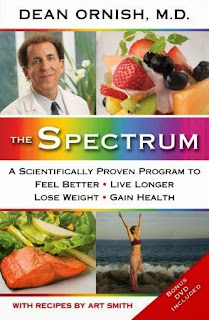
Dr. Ornish's updated version of the latest in research on health, cardiovascular disease, and weight loss.
Dr. Weil's book 8 Weeks to Optimum Health: A Proven Program for Taking Full Advantage of Your Body's Natural Healing Power is great if you want a plan to follow. This is great if you like a more structured plan and he also has a video for people who don't like to read.

I am always surprised by the news, which is why I don't watch it or read it, because it's not news. People forget that news media companies and organizations are financially driven. Their goal is not to inform, but to sell advertisements, or raise donations (NPR). Part of the reason that many things make the news is because they provoke anxiety. Anxiety promotes people reading or watching the news and this sells advertisements. A friend once remarked to me that most news stations have a breaking news segment. They first decide they have breaking news, and then they decide what to fill in that slot.
One way to look at the true state of the world is to look at our goals and agenda. Overall we want to be healthy and happy. We hear so much about the fear of cancer and may fear it is overcoming us, but the reality is that survival rates due to cancer are improving, and death rates are decreasing.
According to the National Cancer Institute, deaths due to cancer have dropped 12% over the last 60 years. The biggest change is a drop of 81% in children under 4. See the Report
Survival rates for cancer have increased from 35% to 69.2% See the Report

